








Should curiosity be the “5th C” of 21st Century Success Skills?

You’re probably familiar with the “4 C’s” – the 21st century success skills of critical thinking, communication, collaboration, and creativity – and know that Project Based Learning is one of the best ways to build them in students. I’d like to propose a fifth “C” for consideration: curiosity. It’s important for success in school, in the world of work, and life in general. It’s not exactly a skill, but like creativity it’s a personal quality that can be cultivated.
However, traditional schooling has the unfortunate tendency to kill students’ curiosity. PBL is the antidote.
Why is Curiosity Important?
First, to beat the drum I usually do when promoting PBL, most students are not as engaged in learning as they should be. This would change if their curiosity was honored in the classroom. Instead of marching through a curriculum that emphasizes standardized tests, mastering skills and facts, and moving at a preset pace, imagine how more engaging school would be if students were given opportunities to ask their own questions and explore answers.
Second, curiosity brings benefits in school and beyond. As progressive education advocate Alfie Kohn puts it, “Curiosity is valuable in its own right—and not just for children. It’s a passport to a richer, more fulfilling life.” Studies have shown that curiosity improves the quality of life in terms of intelligence and learning, social relationships, happiness and meaning, and brain health. Curiosity is “the heart of lifelong learning” says youth development expert and creator of The Compass Advantage Marilyn Price-Mitchell, who placed curiosity on her list of eight “internal abilities” that help children “develop into capable, caring, and engaged adults.”
Education research confirms the value of curiosity. A 2018 study found that “greater curiosity was associated with greater kindergarten reading and math academic achievement…Curiosity may be an important, yet under-recognized contributor to academic achievement… especially for children with low SES.” The researchers defined curiosity as “characterized by the joy of discovery, and the motivation to seek answers to what is unknown.” Another study found that curiosity influenced academic performance: “In fact, it had quite a large effect, about the same as conscientiousness. When put together, conscientiousness and curiosity had as big an effect on performance as intelligence.”
Curiosity is valuable in the modern workplace, too. A 2024 article in Forbes, “Curiosity: The Superpower For Success In The Workplace And At Home,” makes the case:
“In the workplace, curiosity acts as the fuel for innovation and creativity. It encourages individuals to question the status quo, explore new possibilities and think outside the box. This relentless pursuit of knowledge and understanding can lead to the discovery of unique solutions to complex problems and the development of groundbreaking products and services. Organizations that cultivate a culture of curiosity often find themselves at the forefront of their industries, leading the charge toward the future.”
Finally, cultivating a sense of curiosity in its citizens is good for a democratic society. This is the message of Scott Shineoka, author of Seek: How Curiosity Can Transform Your Life and Change the World and keynote speaker at this year’s PBL World event. He argues for greater understanding as a healing process in a polarized nation: “curiosity can help us build relationships, even across differences, even across divides.”
(The message about arriving at mutual understanding is also, btw, delivered by PBLWorks staffer Ryan Sprott in his 2024 book, Teaching Contentious Topics in a Divided Nation.)
How Traditional Schooling Kills Curiosity
“Children enter school as question marks and leave as periods.” So said educator and social critic Neil Postman, paraphrasing progressive educator Lillian Weber. Why is that?
You likely know, especially if you’re a parent, that very young children are intensely curious creatures who ask lots of questions, perhaps hundreds a day. But when a child starts school, the rate drops precipitously, nearing zero by the time they reach middle school. Some of this is due to brain development, and some to social factors; children in a large group in the school setting might feel inhibited from asking too many questions. A big part of the drop, though, is due to the nature of typical schooling today.
Education researcher Susan Engel, in her paper Children’s Need to Know: Curiosity In Schools, reports on a remarkable observation she and her graduate students made when visiting K-5 school classrooms to study curiosity. They planned on examining individual differences between children, seeing whether specific places or activities in a classroom elicited more or less curiosity, and comparing classrooms to one another. However, they were shocked to find out that, “It turned out to be impossible to make the kinds of comparisons we wanted. Why? Because there was such an astonishingly low rate of curiosity in any of the classrooms we visited.”
Engel continues, “If teachers are to promote curiosity, administrators and policy makers will need to emphasize its value. We need to imagine schools as places where curiosity not only survives but flourishes. If curiosity is understood as essential, no less so than solving a geometry problem or writing a good essay, we might see very different classrooms and very different graduates.”
Similarly, after listing some ways teachers can nurture curiosity, Alfie Kohn notes, “Alas, these recommendations for teachers often run smack into structural constraints: an inflexible schedule that doesn’t leave time for exploration; a principal who insists on quiet, orderly classrooms; a central office that imposes a standardized curriculum; a school board that cares more about test scores than about meaningful learning… Much of the problem comes from construing learning as a list of facts to be memorized or discrete skills to be practiced. This premise tends to promote teacher-centered direct instruction, which is often scripted or otherwise tightly controlled.”
Warren Berger, author of A More Beautiful Question: The Power of Inquiry to Spark Breakthrough Ideas, agrees: “...our current system of education does not encourage, teach, or in some cases even tolerate questioning. Harvard’s Tony Wagner says: “Somehow, we’ve defined the goal of schooling as enabling you to have more ‘right answers’ than the person next to you. And we penalize incorrect answers. And we do this at a pace—especially now, in this highly-focused test prep universe—where we don’t have time for extraneous questions.”
The Antidote: 5 Ways PBL Promotes Curiosity
If you’re familiar with Project Based Learning, you’ve no doubt seen how it provokes curiosity in students. Not only does it provoke it–curiosity is baked into the design of a project and fertilized by the culture of a PBL classroom. Let’s look at five features of Gold Standard PBL that elicit, support, and encourage curiosity.
1. Driving Questions
The central question or challenge that frames a good project is open-ended; that’s the key to engaging students’ curiosity. There is no single ”right answer” students are supposed to arrive at; they cannot simply google it, as they can for a “closed” question with a specific answer. Even the teacher doesn’t know the answer, or at least acknowledges there is more than one good answer, so they approach the driving question with curiosity too.
Take a look at these open-ended driving questions from projects designed by PBLWorks (from its project library or the TEACH app). If you were a student, wouldn’t these make you curious?
In grades K-2:
- In case of a fire, what is the best way to safety?
- How can we help new friends get to know our community?
- How does our food connect us to places near and far?
In grades 3-5:
- How can humans safely explore Mars?
- How can we protect endangered species in our area?
- Did the American Revolution have more than two sides?
In middle school:
- What should we do about cyberbullying?
- What masks do we wear when we go about our daily lives?
- How can we increase access to fresh food in our community?
In high school:
- How can we influence the way A.I. is used in our school?
- How can we help a local business make the most money?
- What does it mean to live well, and how do we do it?
2. Entry Events
The first thing that happens in a well-designed, well-implemented project is an event that engages students’ curiosity and sparks questions. The entry event can be anything that alerts students to the project’s topic and grabs their interest–from a live speaker to a field trip to a film clip to a class activity. Along with the driving question, the entry event could connect the project to students’ lived experiences or culture, and/or it might introduce them to a real-world issue or problem to address.
3. Students’ Need to Know Questions
After the entry event and the introduction of the driving question, students generate a list of their own questions to investigate. These questions form the backbone of the inquiry process that is at the heart of PBL. Facilitated by the teacher, students are prompted to ask both process questions about completing the project and more open-ended questions based on curiosity about the topic or problem at hand. Sometimes this is framed as a “Wonder” list. As they dig deeper into the project, students’ add more questions to their list.
4. Student Choice
Because students are given various opportunities to make their own choices in PBL, they need to activate their curiosity: What resources might I use to answer my need to know questions? How can our team work well together? What do I think is the best answer to the driving question? What product or performance could I create? What is my audience or intended stakeholder like?
5. Classroom Culture
One of the Project Based Teaching Practices in PBLWorks’s model for Gold Standard PBL promotes curiosity: Build the Culture, and so does a related Practice, Engage and Coach. A classroom culture that supports PBL, and curiosity, includes a sense of safety; it’s OK to share your ideas and you won’t be put down for it. Your questions matter and will be honored. Think out of the box. The teacher coaches students to surface their questions and be curious about the project’s topic. The teacher also models how to approach the project with curiosity by doing think-alouds–about the driving question, what resources to use, new need to know questions, how to create a product, or the needs of an audience.
There’s a reason why curiosity appears on many "Portraits of a Graduate” being created by school districts today: school communities and stakeholders recognize its importance. It’s often linked to lifelong learning, innovative thinking, resilience, growth mindset, and being self-directed learner. PBL can help these districts move “from poster to practice” and make sure their lofty goals for graduates are reflected in their instructional practices.
And, it’s worth repeating in these times… Curiosity can help a divided nation move from conflict to understanding. Let’s keep our children curious in their school years, so they’ll continue to flex that muscle as adult citizens!
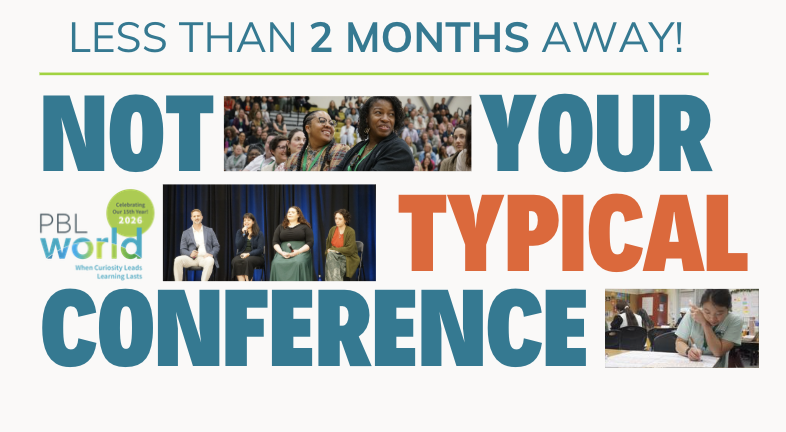
Join me at PBL World this year to hear more about curiosity from our keynote speaker Scott Shineoka –and to learn about building curiosity in the projects your students do.
Alfie Kohn
Kohn, A. (n.d.). Retrieved from https://www.alfiekohn.org
Seymour Sarason
Sarason, S. B. (1996). Revisiting “The Culture of the School and the Problem of Change”. Teachers College Press.
Shah, P. E., Weeks, H. M., Richards, B., & Kaciroti, N. (2018). Early childhood curiosity and kindergarten reading and math academic achievement. Pediatric Research, 84(3), 380–386. https://doi.org/10.1038/s41390-018-0039-3
Forbes
Forbes. (2024). Curiosity: The superpower for success in the workplace and at home.
Scott Shigeoka
Shigeoka, S. (2023). Seek: How Curiosity Can Transform Your Life and Change the World. Grand Central Publishing.